
There is a meeting that happens at most companies running Kubernetes at scale.
Engineering brings allocation numbers from their cost tool.
Finance brings the invoice.
The numbers disagree, nobody can explain the gap precisely, and everyone leaves trusting their own spreadsheet a little more than they did walking in.
The gap is not a bug. It is structural, and it is worth understanding before trying to close it.
Why the estimate cannot equal the invoice
Workload cost in almost every Kubernetes cost tool is computed the same way: collect per-pod CPU and memory over time, multiply by a rate, sum.
The metrics are fine. The rates are the problem.
Those rates are list prices, and your company does not pay list prices. Reserved instances, savings plans, committed use discounts, spot, and whatever your account team negotiated all live in the provider's finalized billing records. The metrics pipeline has no visibility into any of it.
So you get two numbers that are both defensible and never equal. The estimate says one thing. The invoice says another. Every figure derived from the estimate inherits the drift, including any savings claim measured against it.
The tempting fix is to model the discounts. Ingest the reservation inventory, work out coverage, apply spot pricing per instance, amortize the upfront payments. That is a lot of machinery to reproduce something your provider already computed and sent you.
So do the opposite. Instead of reconstructing every reservation, savings plan, negotiated rate, and spot instance, scale the entire allocation to the final invoice with a single factor. Everything else in this article exists to make that one idea correct, deterministic, and auditable.
Scale to the invoice instead
The approach is older than cloud computing. Take the total you can see, take the total you actually paid, and scale.
factor = invoiced_node_cost / estimated_cluster_total
Apply that factor to every line and the bill sums to the invoice. Reservations, spot, and negotiated rates are absorbed into a single ratio without any of them being modelled individually.
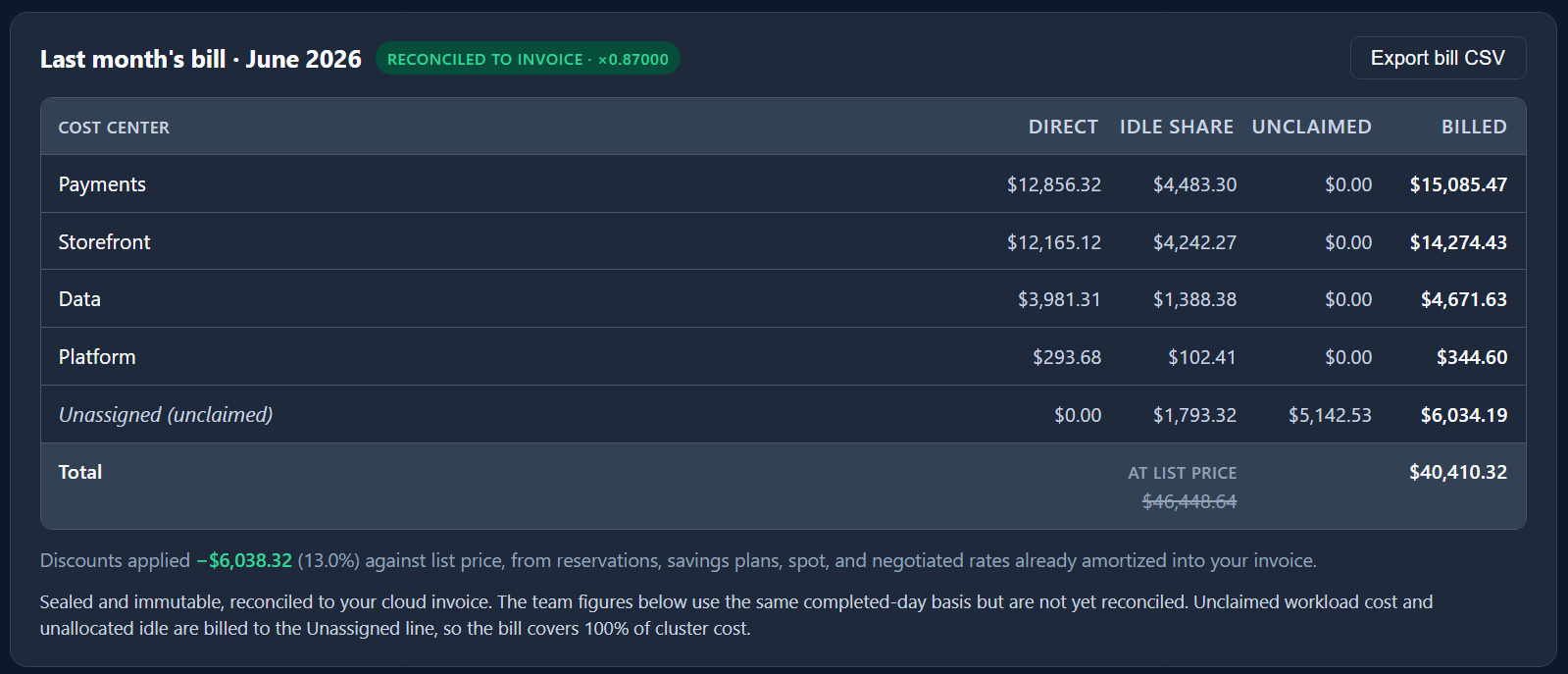
Concretely, for one cluster over one month:
| At list price | Invoiced | |
|---|---|---|
| Cluster estimate, metrics × list rates | $46,448.64 | |
| Amortized compute invoice | $40,410.32 | |
| Factor | ×0.87000 | |
| Sum of every team's billed line | $40,410.32 |
The last row is the point. Not close, not within a rounding tolerance. The same number.
This is the standard showback to chargeback bridge. It is unglamorous and it works, and most of the difficulty is in the details rather than the idea.
One factor per cluster, not per organization
Our first version computed one factor across the whole organization. It was simpler and it was wrong.
A billing link maps a cluster to the account and node filter that identifies its compute on the invoice. Some clusters have one. Some do not: dedicated hardware, bare metal, a cluster billed through an account you do not own.
With a single organization-wide factor, a linked cluster carrying a heavy reservation discount pulls the factor down for every cluster, including ones whose costs were never discounted. Teams on the unlinked cluster get billed less than their cluster cost, and the difference silently lands on everyone else.
Each cluster now reconciles against its own target: its invoice when linked, its estimate when not. The org bill is the merge.
const (
	ReconciliationFull    = "full"    // every cluster reconciled to an invoice
	ReconciliationPartial = "partial" // some clusters reconciled, some estimated
	ReconciliationNone    = "none"    // no invoice applied anywhere
)
Merging is pure addition of already-rounded lines, so each cluster's invariant carries through to the merged one without introducing a new remainder. The blended factor is kept for display only. It is informational, never used for arithmetic.
The cent is the hard part
Scaling is one multiplication. Making the results sum correctly is not.
Three lines of one dollar each, an invoice of ten dollars. Each line scales to 3.333 and rounds to 3.33. The bill sums to 9.99.
A missing cent invites the question of what else is off, and once someone is asking that question about a chargeback report, the report has stopped doing its job.
So the rounding remainder is carried, deterministically, to the largest estimated line, with ties broken by the smallest ID:
sort.Strings(ids) // deterministic iteration regardless of map order

var billedSum float64
carryID := ""
var carryEstimated float64
for _, id := range ids {
	ln := lines[id]
	ln.Billed = roundCents(ln.Estimated * factor)
	lines[id] = ln
	billedSum += ln.Billed
	if carryID == "" || ln.Estimated > carryEstimated {
		carryID, carryEstimated = id, ln.Estimated
	}
}
if carryID != "" {
	if diff := roundCents(report.InvoicedTotal - billedSum); diff != 0 {
		ln := lines[carryID]
		ln.Billed = roundCents(ln.Billed + diff)
		lines[carryID] = ln
	}
}
The sort.Strings matters more than it looks. Go randomizes map iteration order, so without it the cent would land on a different team each month for no reason anyone could explain. A bill you cannot reproduce is not a bill.
Most months the rounded lines happen to sum correctly and the carry does nothing at all. It exists for the months where they do not, which is the only kind of month where anyone notices.
The obvious objection is that money in floats is a bad idea, and integer cents end to end would be better. It would, in isolation. But the upstream metrics pipeline is float all the way down: CPU cores, memory gigabytes, fractional hours, per-unit rates. Converting to integer cents at the boundary moves the rounding decision earlier rather than removing it, and then the same remainder problem appears one layer up with less context to resolve it. So the rule is instead: round to cents at every boundary, and compare exactly.
The invariant, and refusing to seal without it
The property that makes any of this worth trusting is one line:
The sum of every billed line equals the target exactly, at cent precision.
It is asserted before anything is written:
if got, want := bill.BilledSum(), bill.InvoicedTotal; got != want {
	// Never seal a bill that doesn't balance. This is a bug, not data.
	return false, fmt.Errorf("reconciliation invariant broken: billed sum %.2f != target %.2f", got, want)
}
The month fails to close and someone gets paged. That is the correct outcome. The alternative is a bill that is quietly wrong, discovered by a team disputing a number three weeks later, which costs far more than a failed job.
The comparison is != on floats, deliberately. Both sides are cent-rounded before they meet, so exact equality is the right test and an epsilon would be hiding something.
Behind it sits a property test rather than only worked examples: twenty thousand randomly generated attribution reports, random invoices, both unassigned policies, and a third of the runs with no invoice at all. Every iteration asserts the same exact equality, plus that no line is ever billed a negative amount.
Every dollar needs an address
Reconciling to the invoice only works if the estimate covers the whole cluster. If some cost is "reported separately" and left off the bill, the factor is computed against an incomplete denominator and every line is wrong.
Two categories tend to go missing.
Unclaimed workloads. Cost from workloads no team has claimed. Real money, no owner.
Idle residual. The slice of the idle pool with no assigned cost to distribute across. Capacity that ran and that nobody was using.
Both go to an explicit cost center:
// UnassignedCostCenter is the reserved line ID the separate-line policy bills
// to. Double-underscored so it can never collide with a real team ID.
const UnassignedCostCenter = "__unassigned__"
The default is a separate line, so no team is charged for a workload it never claimed while the bill still covers one hundred percent of cluster cost. Organizations that prefer full distribution can spread it proportionally instead. Either way nothing is dropped.
The Unassigned line turns out to be the most useful number on the bill. It is a coverage metric with a dollar sign, and it is visible before chargeback day rather than after the finance meeting.
Four edge cases
Most of the remaining complexity is in situations that look like data problems and are actually real money.
Negative invoice. Credits exceeding node cost. Treated as no invoice, and the bill falls back to estimated rates. Billing teams negative dollars because of a credit is not a defensible outcome, and the underlying billing anomaly should be surfaced rather than distributed.
Invoice of exactly zero, with a positive estimate. A fully credited period. Honored: factor zero, every line zero. Real, and different from having no invoice at all.
Invoice present, nothing attributed. The agent was down all month. The invoice is still real money, so it is billed whole to the unassigned cost center rather than dropped.
No billing link. Factor 1.0, Reconciled false, and the bill is issued at estimated rates. Still a complete bill, just on a different basis, and marked as such. For dedicated hardware the operator-supplied rate is the real cost, so this is correct rather than a fallback. For a cloud cluster it is a known limitation until the link is configured.
When the link points at the wrong thing
The failure mode nobody plans for is a billing link that resolves to the wrong slice of the invoice. It does not error. It produces a bill that balances perfectly against a number that has nothing to do with the cluster.
The only defence is that this kind of mistake is usually not subtle in magnitude. A filter that catches a whole account instead of one node group, or one node group instead of a whole account, moves the factor by multiples rather than percentages.
So the factor has sanity bounds:
if rep.Reconciled && (rep.Factor < 0.2 || rep.Factor > 5.0) {
Outside that range the month refuses to close and retries daily. The reason is written to a close-status record and surfaced on the bill itself, naming the cluster and the factor it produced, so the person who has to fix the billing link reads it on the page rather than in a log they cannot see.
Retrying forever is its own failure, though. Past a configurable deadline the cluster falls back to an estimated bill and the month seals with a partial status, listing that cluster as estimated rather than reconciled. A single misconfigured cluster cannot hold the entire organization's chargeback hostage. Wrong-looking numbers get blocked, and a blocked month does not become a permanently missing one.
The quieter failure is a link that resolves to nothing at all: an account with no matching cost records, or a filter that matches rows outside the days the ledger covers. That produces no error, just an estimated bill for that cluster and a partial status on the org bill. The cluster is listed as estimated so the gap is visible, but working out which of those causes applies means reading server logs. That asymmetry is a rough edge we have not closed yet: a wrong number blocks loudly, a missing link degrades quietly.
Bills are sealed
A bill built from data that can still change is a draft.
Two things have to settle before a month can close. The workload ledger has to be fully sealed for every day in the month, and the provider's amortized billing has to stop restating, which takes a few days past month end. So there is a grace window, four days by default, before the job will even attempt a close.
Reconciliation then runs over sealed days only, never today's live accrual, so the whole bill sits on a single immutable basis. Once written, the month carries its lines, its per-cluster factors, and an audit trail of which clusters reconciled and which did not.
Nothing rewrites it afterward. The seal is enforced in the repository, not just by convention: an attempt to write a month that already exists is refused outright. Corrections happen as a new artifact, never as an overwrite, which is how every other financial system works and for the same reason.
The attribution underneath
None of this helps if the lines being scaled are attributed to the wrong teams.
Pod names are the obvious source of ownership and the wrong one. Deployment ReplicaSets carry a template hash that changes on every rollout, so a claim against a parsed name evaporates at the next deploy. Worse, when name parsing guesses wrong, nothing fails. A dollar figure just lands on the wrong team.
The agent resolves owner references instead, at collection time, against the live object. Deployments take one hop up from ReplicaSet so the stable name is stored. DaemonSets, StatefulSets, and Jobs name a stable owner directly. Bare pods use their own name. Static control-plane pods are technically owned by the Node, so they also use their own pod name, since attributing by owner would collapse every static pod in the cluster into one fake workload.
Every running pod resolves to something named and claimable. That part is covered in more depth in Who Owes for the Cluster?.
What this does not do
The factor is blended. It tells you the aggregate discount applied to a cluster, not which instrument produced it. If you need to know how much came from a savings plan versus spot, this will not tell you.
The scope is compute only. The metrics-derived estimate covers CPU and memory, so the invoice slice is filtered to each provider's compute service. Widening the invoice filter to disks, load balancers, or egress without widening the estimate would inflate the factor and misprice compute. Storage and network belong on the bill as their own line items, not blended into a compute ratio.
Attribution is proportional, not causal. A team's share of idle capacity is proportional to its usage, which is a policy choice rather than a fact about who caused the idle.
And the sanity bounds catch a badly wrong billing link, not a slightly wrong one. A filter that is off by one node group in a fleet of twenty will land inside the bounds and produce a bill that looks entirely reasonable.
Why bother
The argument for doing the accounting properly is not accuracy for its own sake.
It is that a chargeback number nobody can defend produces arguments instead of accountability. Hand finance ten team bills, let them add the column, and get back the number on the invoice. Then the conversation can be about the spend rather than about the spreadsheet.
That is the whole point. The math is boring on purpose.
If you run an optimization platform alongside this, the companion piece on why savings claims need an independent witness is here: Who Audits the Optimizers?
CostOptix does invoice-reconciled Kubernetes chargeback across AWS, Azure, and GCP, alongside multi-cloud cost visibility. Flat pricing, never a percentage of your cloud spend. Read-only access, and a live demo with no signup at demo.costoptix.com.